Choosing the right digital advertising platform can make a significant difference to your business growth. While some businesses use Google Ads to attract customers actively searching for their products or services, others use Meta Ads to reach potential customers through Facebook and Instagram.
Both platforms offer opportunities to increase brand awareness, generate enquiries, drive website traffic, and improve sales. However, their effectiveness depends on your business objectives, target audience, budget, and advertising strategy.
So, when comparing Google Ads vs. Meta Ads in 2026, which platform should your business choose? Let’s explore their differences and how to select the right approach.
1. Understanding Google Ads and Meta Ads
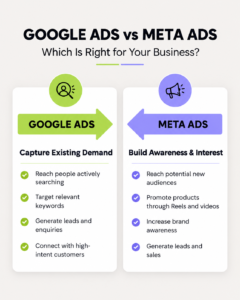
Google Ads helps businesses reach people through Google Search, YouTube, and other participating placements. Search campaigns can display advertisements when users look for specific products, services, or solutions.
For example, someone searching for a website development company in Chennai may already be looking for a service provider. A relevant Google Search advertisement can help your business appear when that demand exists.
Google Ads is particularly useful for:
Reaching customers with specific search intent.
Generating enquiries for services people actively need.
Promoting products through relevant search campaigns.
Reaching audiences through YouTube and other Google advertising formats.
Meta Ads allow businesses to advertise across Facebook, Instagram, Messenger, and eligible Meta placements. It helps businesses reach audiences based on available targeting signals, interests, behaviours, and campaign objectives.
For example, a jewellery store can use Instagram Reels and Facebook advertisements to showcase new collections, promote seasonal offers, and introduce its products to potential customers.
Meta Ads is particularly useful for:
Building brand awareness and product discovery.
Promoting visual content, offers, and new launches.
Generating leads through instant forms or websites.
Re-engaging eligible audiences who have interacted with your business.
The main difference is that Google Search Ads often capture existing demand, while Meta Ads can help create interest among people who may not be actively searching for your offering.
2. Google Ads vs Meta Ads: Key Differences
Although both platforms support business growth, they approach audience discovery and advertising differently.
Audience intent: Google Search Ads can connect your business with people actively searching for relevant solutions. Meta Ads can introduce your brand to potential customers based on audience targeting and campaign objectives.
Advertising formats: Google offers search advertisements, shopping campaigns, YouTube video ads, and other formats. Meta focuses heavily on visual formats, including image advertisements, videos, Reels, Stories, and carousel ads.
Budget and costs: Neither platform is universally cheaper. Costs depend on competition, audience, industry, location, creative quality, bidding strategy, and conversion performance.
Lead quality: Google Ads may generate highly relevant enquiries when search terms reflect strong buying intent. Meta Ads can generate valuable leads when targeting, creative messaging, and lead qualification are properly aligned.
Measurement: Both platforms provide campaign reporting, but businesses should also track qualified enquiries, sales, customer acquisition costs, and revenue to understand the real impact of their advertising.
The right platform is not necessarily the one generating the most clicks or the cheapest leads. It is the one that contributes most effectively to your business goals.
3. Which Platform Is Better for Your Business Goals?
The best advertising platform depends on what you sell, who your customers are, and how they make purchasing decisions.
Choose Google Ads when:
Customers actively search for your products or services.
Your business serves customers with specific needs or urgent requirements.
You want to capture existing demand through relevant search queries.
You can identify valuable keywords that align with your offering.
For example, a plumbing service, legal consultancy, or website development company may benefit from search campaigns targeting people looking for those services.
Choose Meta Ads when:
Your products or services benefit from visual promotion.
You want to introduce your brand to new audiences.
Your business regularly promotes offers, launches, or events.
You want to generate enquiries through Facebook and Instagram.
For example, a fashion retailer, restaurant, jewellery brand, or real estate business may benefit from visually engaging campaigns that showcase products, experiences, and property features.
Can you use both platforms?
Yes. If your budget and resources allow, combining Google Ads and Meta Ads can support different stages of the customer journey.
Meta Ads can introduce your brand and generate interest, while Google Ads can help capture customers searching for your business category or services. Retargeting can also support follow-up where appropriate and consent requirements are met.
Start with the platform most closely aligned with your immediate objective, measure its results, and expand based on evidence rather than assumptions.
4. Common Advertising Mistakes Businesses Should Avoid
Even the right advertising platform can underperform when campaigns lack a clear strategy.
Here are five mistakes to avoid:
Targeting an audience that is too broad: Define your ideal customers, service locations, and relevant audience segments before launching campaigns.
Using unclear advertisements: Communicate what you offer, who it benefits, and what the customer should do next.
Sending every visitor to the homepage: Use relevant landing pages that match the advertisement and make the next step easy.
Measuring only clicks and leads: Track qualified enquiries, appointments, sales, and cost per acquisition wherever possible.
Ignoring campaign optimization: Review search terms, audience performance, creative variations, conversion tracking, and lead quality regularly.
Advertising performance improves when campaign decisions are based on meaningful business outcomes rather than surface-level metrics.
5. How Acquire and Evolve Can Help You Choose the Right Advertising Strategy
At Acquire and Evolve, we help businesses build digital marketing strategies aligned with their goals, target audiences, and growth plans.
Our services include performance marketing, social media management, search engine optimization, creative content, and website design and development. We focus on connecting these activities to create a consistent customer journey, from discovering your business to making an enquiry.
Whether your business needs Google Ads, Meta Ads, or a combination of both, the starting point is understanding your offering, audience, competition, and desired outcomes.
The objective is not simply to spend more on advertising. It is to use your budget strategically, attract relevant prospects, and measure performance against meaningful business goals.
Not sure which advertising platform suits your business?
Contact Acquire and Evolve to discuss your marketing objectives and explore an advertising strategy tailored to your business.
Acquire and Evolve Enabling Business Growth.